The AI revolution is reshaping the stock market landscape, and POET Stock has emerged as one of the most talked-about names in April 2026. POET Technologies, a company specializing in optical engines for AI data centers, has seen its stock price surge dramatically—but it pays zero dividends. So why should income-focused investors care?
The answer lies in portfolio balance, total return optimization, and understanding when strategic growth allocations can enhance your long-term dividend income strategy.
💰 Calculate Your Balanced Portfolio Returns
Before diving into POET stock analysis, smart investors run the numbers on their entire portfolio strategy. Understanding your projected returns across dividend stocks and growth positions is crucial.
👇 Check it out now!
🐳 Dividend calculatorUse Dividend Whale’s calculator to model different allocation scenarios, compare dividend yields, and determine the optimal balance between growth and income for your financial goals.
📊 What is POET Stock? Understanding the AI Optical Revolution
POET Technologies Inc. (NASDAQ: POET) designs high-speed optical engines and modules for artificial intelligence systems and hyperscale data centers. Their proprietary Optical Interposer platform integrates electronics and photonics to address massive bandwidth demands of AI workloads.
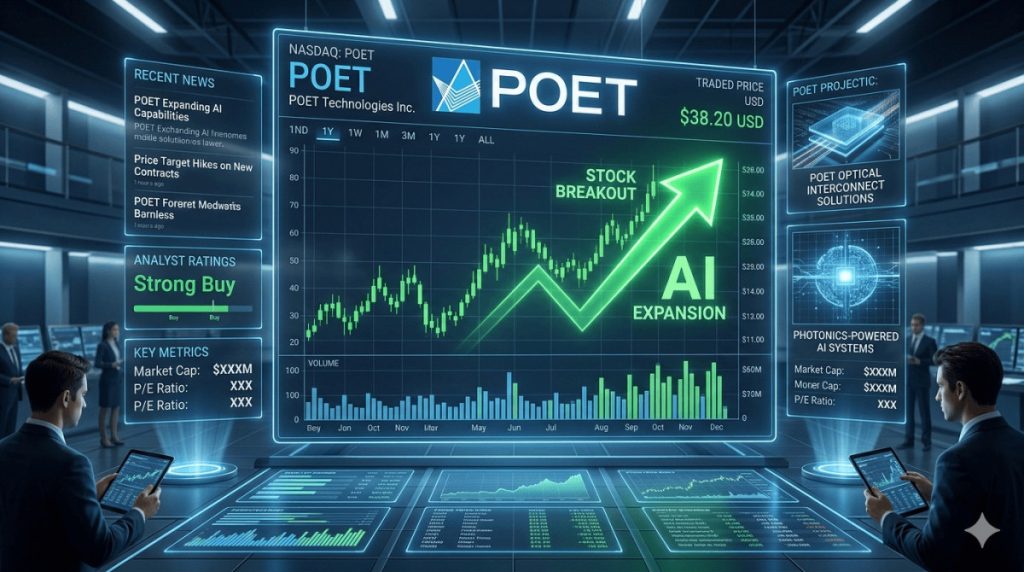
Current Performance (April 2026): Trading between $6.80-$7.70 with high volatility, market cap of $1.1 billion, 52-week range of $3.58-$9.41, and dividend yield of 0%.
Recent Catalysts: POET secured major partnerships with LITEON, multi-million dollar orders for Infinity optical engines, and raised $375 million in financing. Their Malaysia facility is scaling to support 30,000 unit shipments in 2026.
Industry Context: The optical transceiver market could explode from under $10 billion in 2023 to nearly $120 billion within five years, driven entirely by AI infrastructure demands.
📈 Types of AI Optical Stocks
| Type | Examples | Key Features |
|---|---|---|
| Pure-Play Manufacturers | POET, AAOI | Highest AI exposure, extreme volatility, no dividends |
| Integrated Optical | Lumentum, Coherent | Diversified revenue, moderate volatility, minimal dividends |
| Diversified Conglomerates | Marvell, Corning | Lower exposure, reduced volatility, dividend likely |
🔍 POET Stock vs. Dividend Growth Stocks: Key Comparison
| Characteristic | POET Stock | Dividend Growth Stock |
|---|---|---|
| Dividend Yield | 0% | 2-4% |
| Volatility | Very High (50%+ swings) | Low to Moderate (10-20%) |
| Revenue Growth | Explosive (100%+ possible) | Steady (5-15%) |
| Profitability | Currently unprofitable | Consistently profitable |
| Risk Level | High | Low to Moderate |
| Portfolio Role | Alpha generation | Income stability |
| Appropriate Allocation | 5-15% for aggressive investors | 50-80% core holdings |
While POET pays no dividends, potential capital appreciation could exceed total returns of dividend stocks. However, this comes with significantly higher risk as the stock trades on future execution rather than current profitability.
📅 Strategic Timing for Dividend Investors
Dollar-Cost Averaging: Build positions over 6-12 months to manage volatility.
Volatility Capitalization: Set limit orders 10-15% below current price for pullbacks.
Dividend Reinvestment: Redirect 20% of dividends into growth positions.
Milestone-Based: Wait for revenue growth, customer wins, or production milestones before investing.
⚠️ 3 Critical Risks to Check
Risk #1: Execution Failure
POET generates $1.1M revenue with $76.8M annual losses. Manufacturing delays, quality issues, or competitive threats could cause 50-70% declines. Mitigation: Limit to 5% allocation.
Risk #2: Extreme Valuation
Trading at 1,000x price-to-sales. Entire $1.1B market cap rests on projected 2027-2028 revenues that don’t exist. Mitigation: Treat as option on future outcomes.
Risk #3: Dilution Risk
With $75M+ annual burn, may need additional capital before profitability, potentially diluting ownership 20-50%. Mitigation: Exit if cash runway falls below 12-18 months.
💡 POET Stock Is Suitable for These Investors
✅ Aggressive Growth Investors (35-50): 10-15% allocation, long timeframe allows recovery.
✅ Tech-Savvy Investors: 5-10% with active management and sector expertise.
✅ Core-Satellite Strategy: 3-7% in satellite growth allocation with regular rebalancing.
❌ Avoid If: Dependent on portfolio income, unable to tolerate 40%+ drawdowns, or need funds within 3-5 years.
❓ FAQ — Frequently Asked Questions
1. Can POET become a dividend payer? Highly unlikely within 5+ years. Must first achieve profitability and positive cash flow before considering dividends.
2. How much should I allocate? Conservative (60+): 0-3%. Moderate (50-60): 1-5%. Aggressive (35-50): 5-10% maximum.
3. When should I sell? Loss of key customers, two revenue misses, cash below 12-month runway, or position exceeding 15% of portfolio.
4. Buy now or wait? Dollar-cost average over 3-6 months to manage volatility rather than timing single entry.
5. How to monitor POET? Track revenue growth, customer wins, and cash burn separately from dividend portfolio metrics. Review quarterly and rebalance.
📚 References
- POET Technologies Official Website
- NASDAQ POET Stock Page
- Seeking Alpha: AI Optical Revolution Analysis
- Bloomberg: Optical Stocks AI Momentum
⚖️ Disclaimer
This article is for educational purposes only and not financial advice. POET represents high-risk, speculative investment unsuitable for many dividend investors. Early-stage technology companies involve substantial risk of total capital loss.
Before investing, consider your risk tolerance, investment objectives, time horizon, and whether you can afford total loss. Dividend investors should recognize that non-dividend-paying growth stocks fundamentally change portfolio risk and income characteristics.
The author holds no positions in POET Technologies. Always conduct your own due diligence and consult qualified financial advisors regarding your specific situation.