If you’ve been searching for the ultimate breakdown of the SCHD portfolio in 2026, you’ve landed in the right place. The Schwab U.S. Dividend Equity ETF — ticker SCHD — just completed its highly anticipated annual reconstitution in March 2026, shaking up its holdings in a way that has income investors across the U.S., Canada, and the U.K. buzzing. With over $83 billion in assets under management and a track record stretching back to October 2011, SCHD is not just a fund — it’s a cornerstone of modern dividend investing.
In this deep dive, the Dividend Whale 🐳 breaks down everything you need to know: what’s in the SCHD portfolio right now, how the reconstitution changed things, what risks to watch out for, and how to use SCHD portfolio as part of a real dividend-income strategy.
💰 Before You Read — Calculate Your SCHD Dividend Income First
Before we dive into the details of the SCHD portfolio, let’s make it real for your money. How much dividend income could SCHD pportfolio actually generate for you each year? Don’t guess — use the Dividend Whale’s free calculator to run the numbers in seconds.
👇 Check it out now!
🐳 Dividend calculatorFor example, if you invest $50,000 in SCHD at a ~3.3% yield, you’d be looking at roughly $1,650 per year — or about $137 per month — in dividend income, before taxes. Plug in your own numbers and see what’s possible. Then come back and keep reading, because knowing what you own matters just as much as knowing how much you earn.
📊 What Is the SCHD Portfolio? — A Concept Breakdown
SCHD stands for the Schwab U.S. Dividend Equity ETF, launched on October 20, 2011, by Charles Schwab Investment Management. It tracks the Dow Jones U.S. Dividend 100 Index, a rules-based benchmark that selects approximately 100 high-quality, dividend-paying U.S. stocks.
The fund’s core philosophy is simple but powerful: own companies that not only pay dividends today but have the financial strength to keep paying — and growing — those dividends for years to come. To qualify for the SCHD portfolio, a company must:
| Requirement | Detail |
|---|---|
| Dividend history | At least 10 consecutive years of dividend payments |
| Cash flow | Strong free cash flow generation relative to peers |
| Return on equity | High ROE score versus sector peers |
| Dividend growth | Competitive 5-year dividend-growth rate per share |
Once companies pass those screens, they’re ranked by indicated dividend yield and weighted based on a modified market-cap approach. No single stock can exceed roughly 4% of the index, and the entire process is fully mechanical — no portfolio manager’s emotions, market-timing bets, or sector favorites ever enter the equation.
This rules-based, emotion-free structure is a huge part of why so many long-term income investors swear by SCHD portfolio. It systematically identifies high-quality dividend payers and removes the cognitive biases that derail most active strategies.
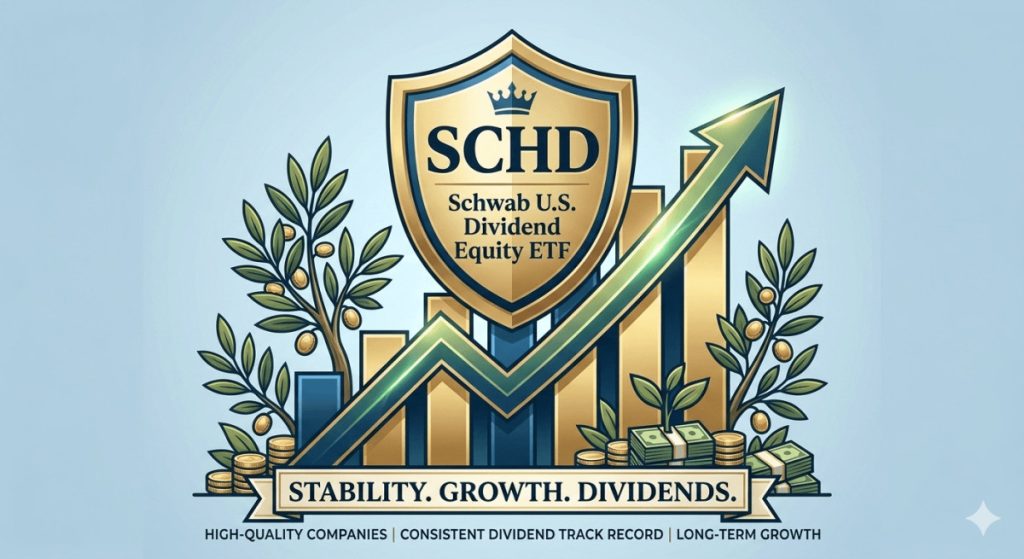
Since inception, SCHD has delivered a cumulative total return of 478%, equating to approximately 13.3% annualized. A hypothetical $10,000 invested at launch would be worth nearly $58,000 today — with dividends reinvested. That’s a remarkable track record for a passive fund focused on income rather than growth.
The expense ratio is a very low 0.06%, making SCHD portfolio one of the most cost-efficient dividend ETFs on the market. It also underwent a 3-for-1 share split in October 2024, making it more accessible to everyday investors.
📈 SCHD Portfolio Holdings & Sector Breakdown — Post-2026 Reconstitution
Every March, SCHD portfolio undergoes its annual reconstitution — the most watched event in the dividend ETF calendar. The March 2026 reconstitution took effect on March 23, 2026, and it brought notable changes.
22 stocks were removed. 25 new stocks were added. Three new names entered the top-10 holdings.
🏆 Top 10 Holdings (Post-March 2026 Reconstitution)
| Holding | Ticker | Approx. Weight |
|---|---|---|
| Texas Instruments | TXN | ~4.34% |
| UnitedHealth Group | UNH | ~4.30% |
| Chevron | CVX | ~4.18% |
| Merck & Co. | MRK | ~4.17% |
| Coca-Cola | KO | ~4.09% |
| Abbott Laboratories | ABT | New addition |
| ConocoPhillips | COP | Holdover |
| Verizon | VZ | Holdover |
| PepsiCo | PEP | Holdover |
| Amgen | AMGN | New to top 10 |
Notable Additions in 2026:
- UnitedHealth Group (UNH) — entered the top 10 after a significant price pullback (~48% decline), making its dividend yield newly attractive under SCHD’s methodology
- Abbott Laboratories (ABT) — strong cash flow and long dividend history secured a top-10 spot
- Procter & Gamble (PG), Qualcomm (QCOM), Accenture (ACN), Comcast (CMCSA), Automatic Data Processing (ADP) — all joined just outside the top 10
Notable Removals in 2026:
- AbbVie (ABBV) — removed after rising prices compressed its yield
- Cisco Systems (CSCO) — fell below quality thresholds
- Halliburton (HAL) — removed after an 80%+ price surge in prior year reduced yield
- Valero Energy (VLO) — same reason; big price appreciation = compressed yield
📂 Sector Allocation (Post-2026 Reconstitution)
| Sector | Approx. Weight | Change vs. 2025 |
|---|---|---|
| Financials | ~18% | ↑ Increase |
| Health Care | ~17% | ↑ Increase |
| Consumer Staples | ~14% | Stable |
| Information Technology | ~13% | ↑ Increase |
| Energy | ~13% | ↓ Decrease (~8pp) |
| Industrials | ~10% | Stable |
| Materials | ~7% | ↓ Slight decrease |
| Other | ~8% | Varies |
The most important headline from the 2026 reconstitution: energy exposure dropped by roughly 8 percentage points after dominating the 2025 portfolio. This shift boosted health care and technology, reflecting SCHD’s mechanical logic — energy stocks ran so hot over the past year that their yields compressed below the fund’s threshold, triggering automatic removal.
🔍 SCHD vs. VIG vs. DGRO — Core Comparison Table
Investors often ask: should I choose SCHD, VIG (Vanguard Dividend Appreciation ETF), or DGRO (iShares Core Dividend Growth ETF)? Here’s the essential comparison:
| Metric | SCHD | VIG | DGRO |
|---|---|---|---|
| Dividend Yield | ~3.3–3.5% | ~1.67% | ~2.13% |
| Expense Ratio | 0.06% | 0.06% | 0.08% |
| AUM | $83B+ | $95B+ | $30B+ |
| 5-Year Div. Growth | ~10%+ | ~8% | ~9% |
| # of Holdings | ~100 | ~330 | ~420 |
| Index Strategy | Quality + Yield | Dividend growth history | Dividend growth + payout |
| Inception | 2011 | 2006 | 2014 |
Key takeaway: SCHD portfolio offers the highest yield of the three at roughly double VIG’s payout. However, SCHD’s concentrated ~100-stock portfolio means more sector and individual-stock risk than VIG or DGRO. If yield-now is your priority, SCHD portfolio wins. If you want the broadest dividend-growth exposure, VIG or DGRO may complement it well.
📅 SCHD Dividend Schedule & Investment Strategy
Dividend Payment Schedule
SCHD portfolio pays dividends quarterly, typically in March, June, September, and December. Here’s what the general timeline looks like each year:
| Quarter | Ex-Dividend Month | Payment Month |
|---|---|---|
| Q1 | Late March | Late March / Early April |
| Q2 | Late June | Late June / Early July |
| Q3 | Late September | Late September / Early October |
| Q4 | Late December | Late December / Early January |
The Q4 distribution is typically the largest of the year, as it often includes additional year-end income. Investors who want to capture a dividend must own SCHD etf shares before the ex-dividend date.
Long-Term Compounding Strategy
The real power of SCHD etf comes from dividend reinvestment (DRIP). Reinvesting dividends automatically buys more shares, which generate more dividends, which buy more shares — the classic compounding snowball. Here’s a simplified illustration:
| Investment | Yield | Annual Dividend | Value After 20 Yrs (DRIP, ~10% total return) |
|---|---|---|---|
| $10,000 | 3.3% | $330 | ~$67,000 |
| $50,000 | 3.3% | $1,650 | ~$337,000 |
| $100,000 | 3.3% | $3,300 | ~$673,000 |
Hypothetical illustration. Past performance does not guarantee future results.
Use the 🐳 Dividend Whale Calculator (link above) to model your own specific scenario with custom annual contributions, different reinvestment rates, and target income goals.
Pairing SCHD with Growth ETFs
Many experienced dividend investors pair SCHD etf with a growth-oriented ETF to balance income with capital appreciation. Popular pairings include:
- SCHD + QQQ — High yield + tech growth
- SCHD + VTI — Income + total market exposure
- SCHD + SCHG — Dividend quality + U.S. large-cap growth
A common allocation is 60% SCHD / 40% growth ETF for investors in the wealth-building phase, shifting toward 80% SCHD / 20% growth as they near retirement and prioritize income.
⚠️ 3 Risks You Must Check Before Investing in SCHD
Every investment has risks, and SCHD etf is no exception. The Dividend Whale 🐳 wants you to go in with eyes wide open. Here are the three most critical risks to understand:
⚠️ Risk 1: Sector Concentration Can Shift Dramatically
SCHD’s mechanical reconstitution means sector weights can swing by 8–10 percentage points in a single year. In 2025, energy jumped from 12% to 21% — a huge swing. In 2026, energy dropped ~8pp while health care and tech rose. If the newly overweighted sectors underperform, SCHD’s returns can lag the broader market for extended periods. Investors need to be comfortable with this uncertainty and avoid assuming the current sector mix will persist.
⚠️ Risk 2: Rising Interest Rates Compress Relative Attractiveness
Dividend ETFs like SCHD etf compete with fixed-income instruments for income-focused investors. When Treasury yields rise significantly above SCHD’s dividend yield (~3.3%), many investors rotate from dividend stocks into bonds — creating selling pressure on SCHD and its holdings. In a “higher-for-longer” rate environment, SCHD may underperform. Always compare SCHD’s current yield against 10-year Treasury yields before investing.
⚠️ Risk 3: Mechanical “Buy Low” Logic Can Catch Falling Knives
SCHD’s methodology automatically adds stocks whose price declines have made their dividend yield attractive. This is powerful in the long run — but in the short term, it means SCHD etf can accumulate stocks that are falling for good fundamental reasons. The 2026 addition of UnitedHealth Group (down ~48%) is a prime example. If a company’s dividend is ultimately cut or eliminated, SCHD will be forced to sell at a loss. The fund’s screening process is rigorous, but no filter is perfect.
💡 Is the SCHD Portfolio Right for You? — Investor Fit Guide
SCHD is a genuinely excellent fund, but it’s not perfect for every investor. Here’s a quick guide:
| Investor Type | SCHD Fit | Reason |
|---|---|---|
| Long-term dividend income seeker | ✅ Excellent | High yield + strong growth history |
| Near-retirement income investor | ✅ Very Good | Reliable quarterly dividends |
| Young investor (20s–30s) | ✅ Good (with growth ETF) | Combine with QQQ or VTI |
| Short-term trader | ❌ Poor | Designed for long-term compounding |
| Investor seeking tech-heavy growth | ❌ Poor | SCHD underweights high-growth tech |
| Fixed-income replacer | ⚠️ Caution | Higher risk than bonds |
| Tax-advantaged account holder | ✅ Excellent | Dividends grow tax-free in IRA/401k |
SCHD is best suited for:
- Investors building a dividend snowball over 10–30 years
- Those who want automatic quality control without picking individual stocks
- Investors who value low cost (0.06% expense ratio) above all
- Anyone who wants a core holding that can anchor a diversified income portfolio
SCHD may not be ideal for:
- Investors who need capital growth faster than dividend income provides
- Those uncomfortable with sector-concentration swings year to year
- Investors in high-tax brackets who hold SCHD in taxable accounts without a plan
If you’re unsure whether SCHD is right for your financial situation, run a few scenarios through the 🐳
❓ FAQ — 5 Questions Investors Ask Most About the SCHD Portfolio
Q1. How often does SCHD reconstitute its portfolio?
SCHD reconstitutes once per year, typically in March. The Dow Jones U.S. Dividend 100 Index is rebuilt from scratch using its rules-based methodology, and the ETF rebalances its actual holdings to match on a specified effective date (March 23 in 2026). Smaller rebalances can also occur quarterly, but the major annual reconstitution is the headline event that drives most media coverage and investor discussion.
Q2. What is the current SCHD dividend yield in 2026?
As of April 2026, SCHD’s dividend yield sits in the range of approximately 3.3% to 3.5%, depending on the share price at the time of measurement. This is notably higher than comparable dividend ETFs: VIG offers roughly 1.67% and DGRO around 2.13%. The yield fluctuates daily as the share price moves, so always check a live source like Schwab Asset Management or StockAnalysis for the current figure before making any investment decision.
Q3. What happened to SCHD during the April 2026 market volatility?
SCHD dropped to approximately $23.85–$23.90 per share in early April 2026 amid broad market selloffs triggered by tariff escalations and recession fears. However, the fund rebounded quickly to around $27 — its highest since early April — as investors rotated back into defensive dividend stocks. This resilience reflects SCHD’s defensive tilt: its holdings in consumer staples, health care, and energy tend to hold up better than the broader market during risk-off periods.
Q4. Should I pair SCHD with other ETFs, or hold it alone?
Most experienced investors do not hold SCHD alone. While SCHD’s ~100-stock portfolio offers excellent dividend quality, it has relatively limited exposure to high-growth sectors like technology. Many investors pair it with a growth ETF (such as QQQ, SCHG, or VTI) to balance income with capital appreciation. A common rule of thumb: the closer you are to retirement, the higher your SCHD allocation. In the wealth-building phase, a 50/50 or 60/40 SCHD-to-growth split is popular.
Q5. Is SCHD a good buy after the 2026 reconstitution?
Based on the mechanics of how SCHD works, the 2026 reconstitution actually upgraded the portfolio’s long-term dividend growth potential. The newly added stocks average a ~63% five-year dividend-growth rate, compared to ~37% for the removed holdings. The fund sold last year’s winners (energy stocks with compressed yields) and bought quality names that have pulled back significantly in price. For long-term income investors, this is precisely the kind of disciplined “buy low, sell high” execution that has driven SCHD’s 478% cumulative return since 2011. Whether it’s a good buy for you depends on your time horizon, tax situation, and broader portfolio context.
📚 References
- Schwab Asset Management — SCHD Official Product Page
- StockAnalysis — SCHD Overview & Dividend History
- StockAnalysis — SCHD Holdings
- The Motley Fool — SCHD Annual Reconstitution 2026
- 24/7 Wall St. — SCHD Just Made Big Changes
- Seeking Alpha — SCHD: My Top Income Growth Pick
- ETF Database — SCHD Full Profile
⚖️ Disclaimer
This article is for informational and educational purposes only. It does not constitute financial, investment, tax, or legal advice. All data and figures cited are based on publicly available information as of April 2026 and are subject to change. Investing involves risk, including the possible loss of principal. Past performance is not indicative of future results. The Dividend Whale and wealthtrendguide.com are not registered investment advisors. Always conduct your own due diligence and consult a qualified financial professional before making any investment decisions.